
What we do, how and why
Leading solvation research
Which role do solvent molecules play in proteins, at electrodes, in sustainable reaction control or in the origin of life? Since 2012, we have been combining our expertise in chemistry, biochemistry, physics, and chemical engineering to answer such questions.
We apply cutting-edge spectroscopic and microscopic techniques, advanced computational and AI-assisted methods, and novel synthesis strategies, many of which have been pioneered in RESOLV, for understanding and controlling solvent-driven processes at the molecular level.
RESOLV's mission is to advance the global research environment of Solvation Science to ensure the rapid transfer of research findings into key innovative technologies and to inspire the scientists of tomorrow.
Exploiting the transformative power of Solvation Science is key to address urgent scientific and societal challenges, such as replacing fossil carbon by renewable sources, electrifying chemical production and minimizing environmental impacts or optimizing the functionality and long-term stability of formulations for life science products.
RESOLV trains more than 80 PhD students, collaborates with over 20 partners around the world, fosters diversity and equity as well as the rapid translation of ideas into products.
Scientists

Who we are
200 scientists from 6 institutions in the German Ruhr Area team up in the Cluster of Excellence RESOLV (Ruhr Explores Solvation). Ruhr University Bochum (RUB) and TU Dortmund University (TUDo) co-host the cluster.
Prof. Dr. Martina Havenith from RUB, Prof. Dr. Gabriele Sadowski from TUDo, and Prof. Dr. Viktoria Däschlein-Gessner from RUB are the cluster spokespersons and coordinators.






Strategic Partnerships
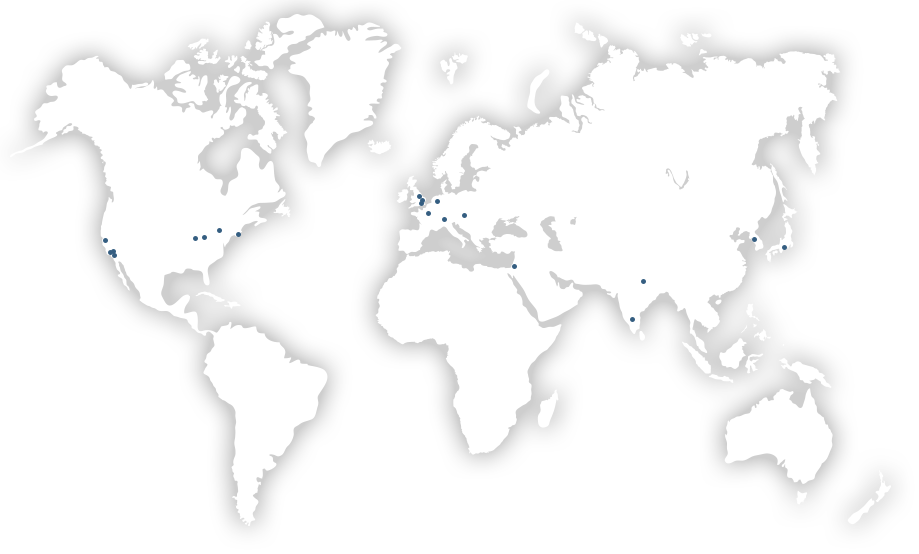
International Faculty
Our international network of more than 20 top institutions reaching from the US to Europe and Asia.
Partner Institute CALSOLV
California explores Solvation, our partner consortium at UC Berkeley, enables fruitful scientific exchange.
Local
Partners
Six strong institutions from the Ruhr area join forces to do excellent research on Solvation Science.

Zemos
Home of Solvation science
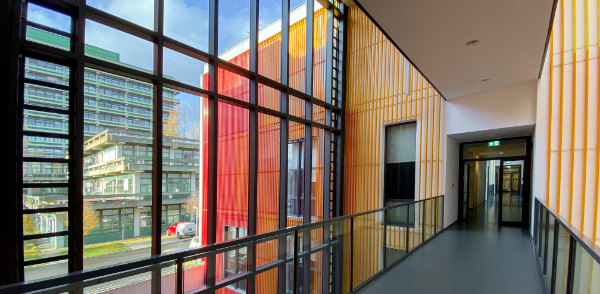
The research building at Ruhr University Bochum
The Center of Molecular Spectroscopy and Simulation of Solvent-driven Processes (ZEMOS – short in German) is the first research building for Solvation Science in the world. Co-funded by the German Federal Government and the State of North Rhine-Westphalia, ZEMOS opened in May 2016. The four-story construction has an S shape that recalls the first letter of the main technology platforms hosted inside: spectroscopy and simulation for Solvation Science.
In ZEMOS, architecture and design come together to foster innovative and unconventional scientific thinking: In the colorful and transparent interior, national and international scientists find bright offices, shared spaces for scientific discussions, and place for large equipment.
Find out more

Funding
44 MIO. €

Total Area
4000 M2

Scientists
OVER 100

Interdisciplinarity
6 DISCIPLINES

CALEDO
Application of Solvation science
The research building at
TU Dortmund University
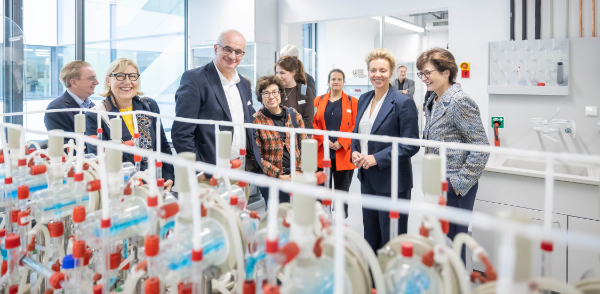
The Center for Advanced Liquid-Phase Engineering Dortmund (CALEDO), co-funded by the German Federal Government and the State of North Rhine-Westphalia, was officially opened in October 2025. The research in CALEDO focusses on the exploration of fundamental knowledge and deep understanding of solvent effects focusing on designing liquid phases to serve as reaction media for innovative applications in chemistry and biotechnology as well as for life sciences formulations.
The core facilities in CALEDO encompasses cutting-edge equipment for NMR spectroscopy, X-ray, light-scattering techniques, mass spectrometry, an automated liquid-handling platform and reactor setups for chemical synthesis as well as GMP-compliant laboratories for pharmaceutical formulations.
Funding
70 MIO. €
Total Area
3600 M2
Scientists
OVER 100
Connecting Science &
APPLICATION