RESOLV kicks off its 3rd funding period (2026 to 2032)

RESOLV kicks off its 3rd funding period (2026 to 2032)

Seven exciting years ahead: We continue to spearhead new advances in Solvation Science from our leadership position as creators of the field.

WE ARE RESOLV

WE ARE RESOLV

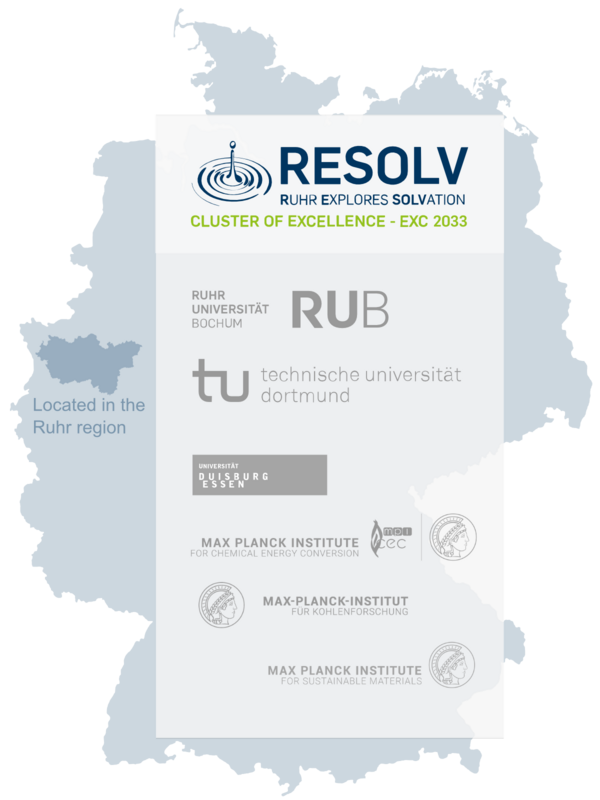
Over 200 scientists from about 50 research groups in 6 institutions

RUHR EXPLORES SOLVATION

RUHR EXPLORES SOLVATION

We shape a new scientific discipline, inspire the scientists of tomorrow, and enable future technologies

Diversity, Equity, and Inclusion (DEI) in Science Day

Diversity, Equity, and Inclusion (DEI) in Science Day

Equity and diversity as a source of strength, fundamental to innovative ideas, and a prerequisite for excellence in science

Summer School Solvation Science

Summer School Solvation Science

We are happy to welcome young Solvation Scientists every year after Whitsun in Bochum

World Science Day

World Science Day

Building strong networks between academia and industry

ZEMOS: Home of Solvation Science @RUB

ZEMOS: Home of Solvation Science @RUB

The first research building for Solvation Science in the world

CALEDO: New Research Building for Solvation Science @TU Dortmund

CALEDO: New Research Building for Solvation Science @TU Dortmund

Center for Advanced Liquid-Phase Engineering.

WHAT is RESOLV?

The Cluster of Excellence RESOLV is an interdisciplinary research project of the Ruhr University Bochum and the TU Dortmund University, as well as four other institutions in the German Ruhr area. Since 2012, about 200 scientists cooperate to clarify how the solvent is involved in the control, mediation and regulation of chemical reactions. Our research is essential to advance technologies that could reuse CO2 for chemicals production, increase the efficiency of energy conversion and storage and develop smart sensors. Over its third funding period (2026-2032), RESOLV is supported by the German Federal Government and the state of North Rhine-Westphalia with 43 Mio. Euro. 
 

Find out more

Video: THIS is RESOLV

RESOLV pioneered Solvation Science as an interdisciplinary research field. It has transformed its host universities into excellent research ecosystems and embedded researchers at all stages of their careers in an international network of scientists.

Latest News or browse all

Posted on

TERAHERTZ DANCE OF AMINO ACIDS

JACS: RUB chemists explain the fingerprint of dissolved glycine in the Terahertz range - Combination of molecular-dynamics simulations and spectroscopy is key to success. The team led by Prof Dr Martina Havenith-Newen and Prof Dr Dominik Marx published their report in the “Journal of the American Chemical Society”.

Chemists at the Ruhr-Universität Bochum (RUB) have, for the first time, completely analysed the fingerprint region of the Terahertz spectrum of a biologically relevant molecule in water, in this case, an amino acid. By combining spectroscopy and molecular-dynamics simulations, they rendered the motion of the most basic amino acid, glycine, visible in an aqueous solution. Their results have disproved the long-standing theory that frequencies in the Terahertz range provide no information regarding the amino acid’s motion. The team led by Prof Dr Martina Havenith-Newen and Prof Dr Dominik Marx published their report in the “Journal of the American Chemical Society” (JACS).


read more

Posted on

TERAHERTZ DANCE OF AMINO ACIDS

JACS: RUB chemists explain the fingerprint of dissolved glycine in the Terahertz range - Combination of molecular-dynamics simulations and spectroscopy is key to success. The team led by Prof Dr Martina Havenith-Newen and Prof Dr Dominik Marx published their report in the “Journal of the American Chemical Society”.

Chemists at the Ruhr-Universität Bochum (RUB) have, for the first time, completely analysed the fingerprint region of the Terahertz spectrum of a biologically relevant molecule in water, in this case, an amino acid. By combining spectroscopy and molecular-dynamics simulations, they rendered the motion of the most basic amino acid, glycine, visible in an aqueous solution. Their results have disproved the long-standing theory that frequencies in the Terahertz range provide no information regarding the amino acid’s motion. The team led by Prof Dr Martina Havenith-Newen and Prof Dr Dominik Marx published their report in the “Journal of the American Chemical Society” (JACS).


read more

VISIT us on Bluesky

@SolvationSci

VISIT us on LiNKEDIn

Cluster of Excellence RESOLV

Our scientific fields

Research Area I

Charge and Electron Transfer


READ MORE

Research Area II

Solvent Design for Chemical Processes


READ MORE

Research Area III

Tuning Stability and Homogeneity


READ MORE

Upcoming Events or browse all

Posted on

TERAHERTZ DANCE OF AMINO ACIDS

JACS: RUB chemists explain the fingerprint of dissolved glycine in the Terahertz range - Combination of molecular-dynamics simulations and spectroscopy is key to success. The team led by Prof Dr Martina Havenith-Newen and Prof Dr Dominik Marx published their report in the “Journal of the American Chemical Society”.

Chemists at the Ruhr-Universität Bochum (RUB) have, for the first time, completely analysed the fingerprint region of the Terahertz spectrum of a biologically relevant molecule in water, in this case, an amino acid. By combining spectroscopy and molecular-dynamics simulations, they rendered the motion of the most basic amino acid, glycine, visible in an aqueous solution. Their results have disproved the long-standing theory that frequencies in the Terahertz range provide no information regarding the amino acid’s motion. The team led by Prof Dr Martina Havenith-Newen and Prof Dr Dominik Marx published their report in the “Journal of the American Chemical Society” (JACS).


read more

summer school Solvation Science

RESOLV hosts an annual summer school at ZEMOS, Ruhr-Universität Bochum. The school always takes place after Whitsun and is an integral part of the integrated Graduate School Solvation Science (iGSS) students' training during their doctoral studies. Scholarships for international students and PhD candidates are also available upon admission. 

International speakers, suggested by a committee of iGSS students and RESOLV postdocs, are invited to give keynote talks on their research in the field of Solvation Science. In career-boosting workshops, school participants may meet industry professionals or fine-tune their personal skills. The Advanced Laboratory Modules give the students an excellent opportunity to learn new and interesting experimental and theoretical techniques within a specific research topic of their own choice. 

Find out more

Publication highlights

W. Chen, M. Gruebele, M. Havenith, K. J. Hebel, C. Scaletti, Water-mediated Hydrogen Bonds and Local Side Chain Interactions in the Cooperative Collapse and Expansion of PNIPAM Oligomers, Proc. Natl. Acad. Sci. U.S.A 123, e2523755123 (2026), 10.1073/pnas.2523755123

D. L. Reinhard, A. Iniutina, S. Reese, T. Shaw, C. Merten, B. List, S. M. Huber, Asymmetric Counteranion-Directed Halogen Bonding Catalysis, J. Am. Chem. Soc. 147, 8107-8112 (2025). 10.1021/jacs.4c18378

S. Ghosh, C. K. Das, S. Uddin, S. T. Stripp, V. Engelbrecht, M. Winkler, S. Leimkuhler, C. Brocks, J. Duan, L. V. Schäfer, T. Happe, Protein Dynamics Affect O2-Stability of Group B [FeFe]-Hydrogenase from Thermosediminibacter oceani, J. Am. Chem. Soc. 147, 15170-15180 (2025). 10.1021/jacs.4c18483

S. S. Nalige, P. Galonska, P. Kelich, L. Sistemich, C. Herrmann, L. Vukovic, S. Kruss, M. Havenith, Fluorescence changes in carbon nanotube sensors correlate with THz absorption of hydration, Nat. Commun. 15, 6770 (2024). 10.1038/s41467-024-50968-9

F. Novelli, K. Chen, A. Buchmann, T. Ockelmann, C. Hoberg, T. Head-Gordon, M. Havenith, The birth and evolution of solvated electrons in the water, Proc. Natl. Acad. Sci. U.S.A. 120, e2216480120 (2023). 10.1073/pnas.2216480120

T. van Lingen, V. Bragoni, M. Dyga, B. Exner, L. Gooßen, D. Schick, C. Held, G. Sadowski, Carboxylation of Acetylene without Salt Waste: Green Synthesis of C4 Chemicals Enabled by a CO2-Pressure Induced Acidity Switch, Angew. Chem. Int. Ed. 62, e202303882 (2023). 10.1002/anie.202303882

J. F. Goebel, J. Löffler, Z. Zeng, J. Handelmann, A. Hermann, I. Rodstein, T. Gensch, V. H. Gessner, L. J. Gooßen, Computer-Driven Development of Ylide Functionalized Phosphines for Palladium-Catalyzed Hiyama Couplings, Angew. Chem. Int. Ed. 62, e202216160 (2023). 10.1002/anie.202216160


find out more