
Ebbinghaus Group
Solvent-Mediated Proteome Stability: Elucidating Cold Unfolding Kinetics in Living Cells
Please discuss your project with a possible supervisor, Prof. Simon Ebbinghaus via email Simon.Ebbinghaus(at)rub.de before you fill out the application.
About the group and the topic
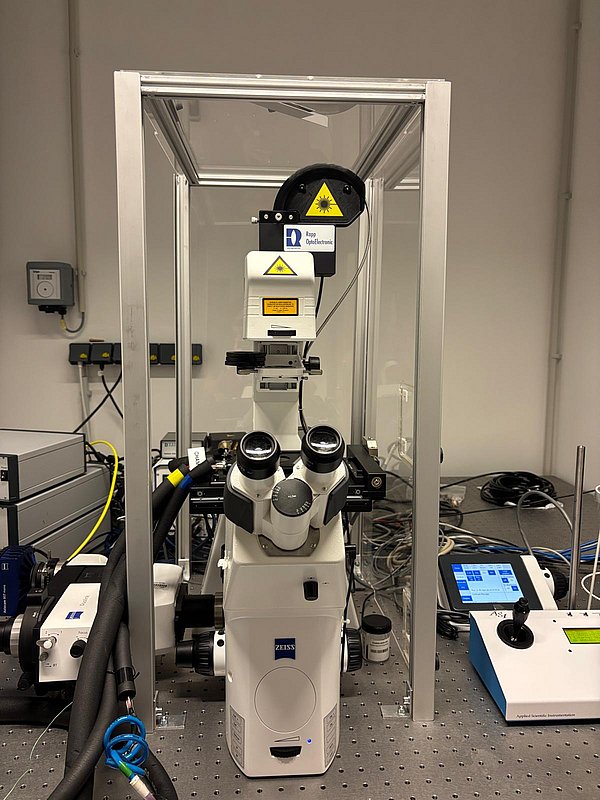
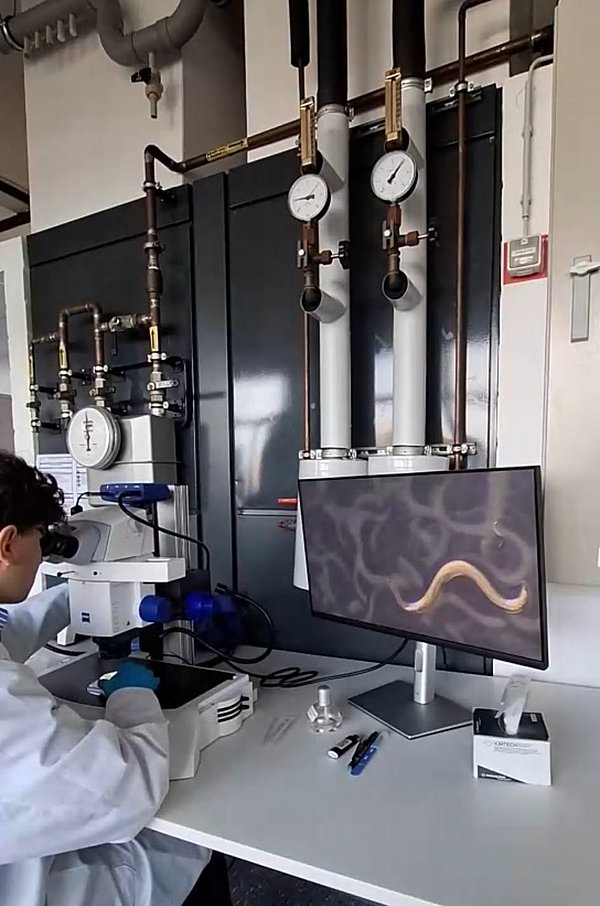
While classical thermodynamics has established the mechanisms of heat-induced protein denaturation, cold denaturation mechanisms remain elusive. Observing cold unfolding in proteins is crucial to understanding species adapted to low-temperature environments, yet remains extremely challenging as it typically occurs below 0^∘ "C" . In the crowded, non-ideal environment of a living cell, hydration dynamics and macromolecular crowding fundamentally alter protein stability curves, leading to structural instability at low temperatures. Precisely measuring these delicate thermodynamic transitions in real time requires sub-degree temperature control, high-resolution live-cell spectroscopy, and advanced structural probes. We invite pioneering researchers to overcome this complex analytical challenge: leverage state-of-the-art tools for live-cell analysis, such as Fast Relaxation Imaging Microscopy, to elucidate the thermodynamic forces driving cold-induced denaturation and set a new standard for research on functional proteins under extreme thermal conditions.
What they expect from students
From the applicants we would expect basic knowledge of biochemistry and spectroscopy. Experience in related fields is advantageous.

How to apply
For your application, you will need to upload your:
- Research proposal (1 page)
- CV with contact details and affiliation (max. 2 pages)
- Letter of motivation related to Solvation Science (1 page)
- Diploma of your finished education level (Bachelor or Master) and transcript. Please don't send a transcript of the middle of the course.
Prerequisites: Current Master's and PhD students in the fields of Natural Sciences, Medical Sciences, or related topics of Engineering
The program is officially open. New Application deadlines will be 1. December 2026, 1 March 2027 and 1 June 2027.
The results of first application deadline will be announced before 20. December 2026.
Win a research stay
Subject: enact your research proposal
Duration: 3 months
Location: Ruhr University Bochum, Technical University Dortmund,University Duisburg-Essen, Max-Planck-Institut
Language of instruction: English
Funding: RESOLV sponsors travel (reimbursement) and a monthly stipend
Period of research stay: before December 2027